01
Potential Emission Reduction
Improved rice-farming practices may potentially reduce greenhouse-gas emissions compared with an established baseline, subject to the applicable methodology.
 EarthCred
Understand carbon credits, discover how projects create measurable emission reductions, and explore the emerging Indian carbon market through one premium digital experience.
Illustrative unit of carbon reduction, removal or avoidance.
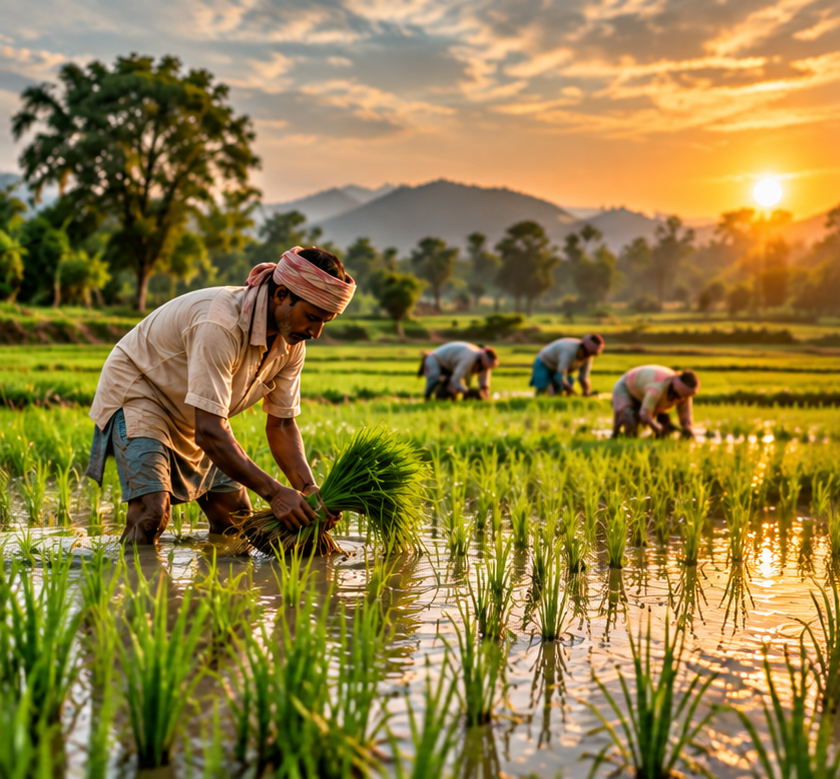
Rice cultivation can generate greenhouse-gas emissions, particularly methane associated with flooded rice fields.
EarthCred identified an opportunity to work with local farmers to introduce improved rice-farming practices that could potentially reduce emissions while maintaining agricultural productivity.
EarthCred approached a group of 500 farmers and explained the concept of carbon credits.
The farmers were told:
“If we can demonstrate that specific farming practices reduce greenhouse-gas emissions compared with an established baseline, those verified reductions may potentially be converted into carbon credits under an applicable carbon-crediting system.”
Before making changes, EarthCred collected information about the participating farms, including:
This information was used to establish the project’s baseline and determine how emissions would be calculated under the applicable methodology.
Participating farmers introduced agreed sustainable practices, such as improved water management and other applicable agricultural practices. They received training and guidance from the project team, and EarthCred established a system for collecting and maintaining project data.
The project team then monitored the participating farms throughout the project period, to determine the potential emission reduction:
For this hypothetical example, suppose the project calculations indicate a total potential reduction of:
EarthCred cannot simply declare:
The project’s calculations and supporting evidence would need to go through the applicable validation, monitoring and independent verification procedures — an appropriately qualified organization would examine the documentation, data, calculations and evidence. Only if the project satisfies the applicable requirements could credits potentially be issued.
Suppose, purely for this hypothetical example, that 25,000 carbon credits are issued. Under a system where one credit represents one tonne of CO₂-equivalent:
EarthCred approaches companies interested in purchasing eligible carbon credits. The buyer conducts its own due diligence and evaluates:
Suppose a buyer agrees to purchase the credits — revenue is then distributed per the contractual arrangements between participants and EarthCred, after applicable costs. The farmers may potentially benefit in two ways:
The exact amount received by each farmer would depend on the project's actual economics and the agreement established before the project begins.

The most important principle of the project is:
EarthCred would maintain records showing the full chain of custody:
This creates a transparent chain from the farmer’s field to the final carbon credit.

The hypothetical Punjab project begins with 500 farmers. If the model proves technically and commercially viable, EarthCred could potentially expand the approach:
The long-term vision would be to create a platform connecting:
The goal would not simply be to sell carbon credits. The goal would be to create a system where measurable environmental improvements can potentially create an additional economic opportunity for farmers and businesses.
This is a hypothetical project created for illustration and presentation purposes.
The farmers, project results, 25,000 tonnes CO₂e reduction, issuance of 25,000 credits, buyer and transaction described above are fictional assumptions. Actual carbon-credit projects require an appropriate methodology, project eligibility assessment, monitoring, documentation and independent validation/verification before credits can legitimately be issued or marketed as verified credits.
Better agricultural practices can potentially create environmental benefits while supporting an additional economic opportunity for participating farmers.
Rice farming practices can influence greenhouse-gas emissions, particularly methane from flooded fields.
Training, agreed practices and reliable project data are central to the approach.

Water management and other applicable practices can be monitored and measured.
The hypothetical model is designed around environmental measurement, farmer participation and transparent project economics.
Improved rice-farming practices may potentially reduce greenhouse-gas emissions compared with an established baseline, subject to the applicable methodology.
Participating farmers may potentially receive an additional income stream from the carbon project alongside their agricultural income.
Farm-level information, monitoring and calculations create a documented basis for assessing the project's environmental benefit.
Participant records, methodology, verification, issuance and transaction information can create a traceable chain from farm activity to carbon credit.
Start with knowledge before making any climate-market decision.